
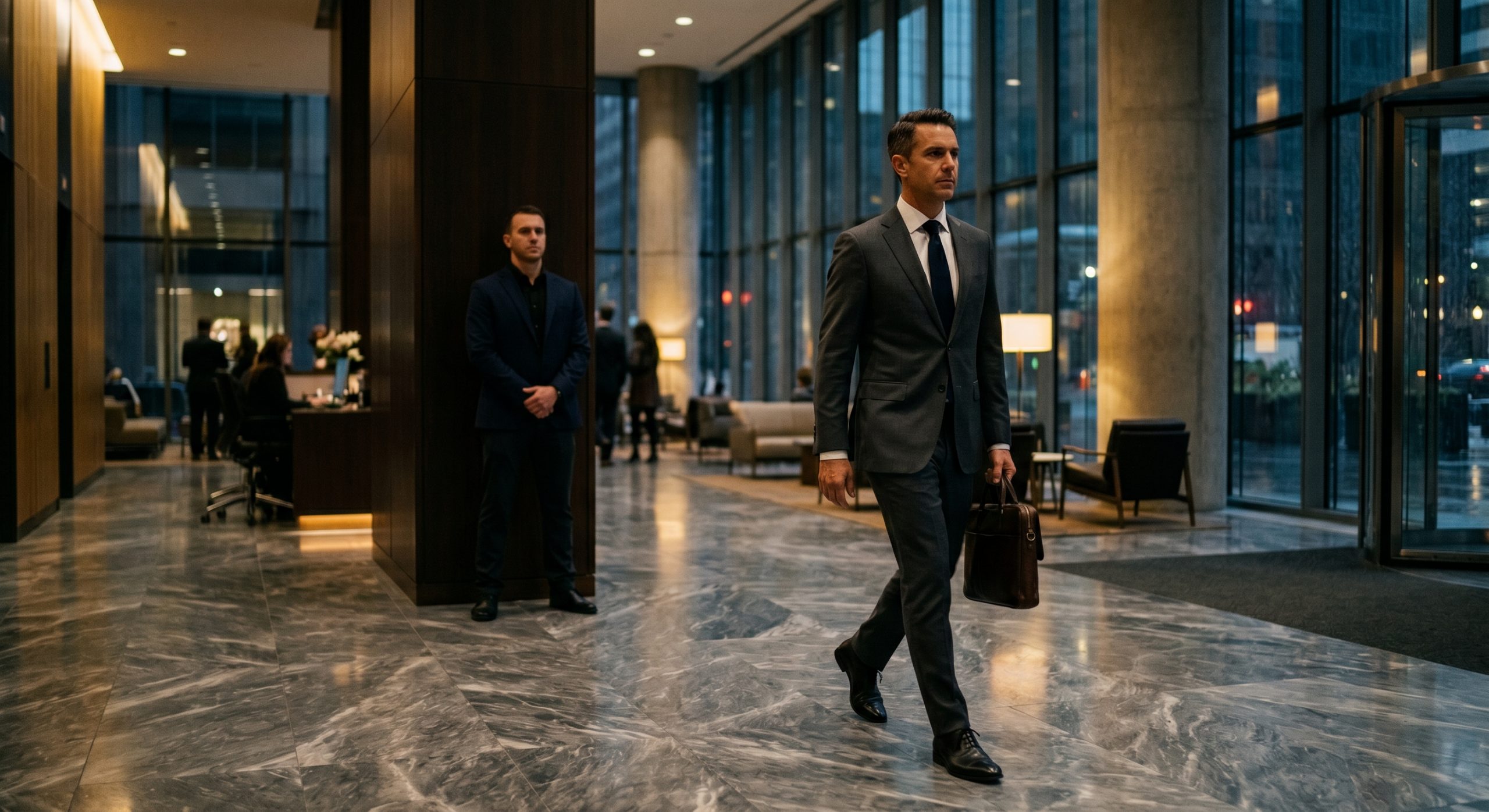
Most people think security is measured by what they can see.
The visible presence. The earpiece. The black SUV. The person standing near the entrance scanning the room.
Those things certainly have their place, but they are not what defines effective security.
In reality, the best security operations are often the ones nobody notices at all.
Nothing happens.
The meeting starts on time.
The executive arrives without disruption.
The event runs smoothly.
Employees go home safely.
The campus continues operating normally.
No headlines are written. No incidents are reported. No one remembers there was security involved in the first place.
That isn’t failure.
That’s success.
The Hollywood Problem
Popular culture has done an excellent job of teaching people what security looks like — and a poor job of teaching people what security actually does.
Movies tend to portray protection as a reaction. Someone spots a threat. Someone draws a weapon. Someone makes a dramatic decision under pressure.
While those moments occasionally occur in real life, they represent a tiny fraction of the work that goes into maintaining a secure environment.
The majority of effective security happens long before anyone realizes there was ever a risk. It happens during planning. It happens during coordination. It happens during intelligence gathering. It happens when someone notices a vulnerability before it becomes a problem.
The most valuable security decisions are often the ones that prevent situations from developing in the first place — and that starts with the right foundation. Our Security Consulting work is built entirely around that principle: identify the gap before it opens, not after.
Stability Is the Real Objective
One of the most common misconceptions about security is that the goal is protection.
Protection is certainly part of the equation, but it is not the ultimate objective.
The real objective is stability.
Organizations don’t hire security providers because they want more security personnel around them. They hire them because they want their operations to continue uninterrupted. Executives want to focus on leading. Institutions want to focus on educating. Organizations want to focus on serving customers and growing their business.
Security exists to support those outcomes.
When done correctly, it becomes part of the environment rather than the center of attention. That’s the standard our Executive Protection teams operate to — capability that moves with you, not around you.
Why Visibility Isn’t Always the Answer
There are situations where a visible security presence is necessary.
However, visibility alone should never be mistaken for effectiveness.
In some environments, excessive visibility can actually create unnecessary tension, distraction, or operational friction. A highly visible presence may reassure some people while making others uncomfortable.
The challenge is finding the right balance between preparedness and disruption.
Professional security teams understand that every environment is different. What works for a diplomatic event may not work for a corporate board meeting. What works for a public gathering may not work for a university campus.
The solution is rarely one-size-fits-all. It requires understanding the environment, the people involved, and the objectives that need to be protected. That’s exactly the work we do through our Protective Services — tailored to your risk profile, not a generic template.
Most Risks Don’t Arrive Unannounced
Another misconception is that incidents appear out of nowhere.
In reality, many operational disruptions leave indicators long before they become visible problems. Workplace concerns often show warning signs. Travel risks often emerge through changing conditions. Public-facing events often present logistical vulnerabilities before attendees arrive. Reputational threats frequently develop gradually before they attract widespread attention.
The organizations best positioned to navigate these situations are not necessarily the ones with the largest security budgets. They are the ones paying attention.
Awareness creates options. Options create time. Time creates better decisions. And better decisions often prevent disruption altogether.
That kind of continuous situational awareness is precisely what Vigil, our protective intelligence platform, is built to provide — monitoring the landscape so your team can operate informed rather than reactive.
A Different Way to Think About Security
At Samaritan, we believe the most effective operations are the ones that allow people to continue doing what they do best.
Our role is not to become the focus of the environment. Our role is to support it.
That means helping executives move confidently through complex environments. It means helping organizations maintain continuity during sensitive situations. It means supporting institutions, campuses, events, and leadership teams with the awareness and preparation needed to navigate uncertainty professionally.
The objective is not visibility.
The objective is stability.
Because when security is done well, most people will never notice it was there.
And that’s often the clearest sign it was working exactly as intended.
Ready to build a security posture that works quietly and effectively?
If you’re responsible for protecting people, assets, or operations, the right time to have this conversation is before something happens — not after.
Connect with our team to discuss your environment and what a tailored approach could look like for your organization.